

Krakow, 23/Jan/2014
IHRA’s conference on “Killing Sites – Research and Remembrance” under the Multi-Year Work Plan took place in Krakow, Poland from 22-23 January 2014.
The conference, hosted by the Pedagogical University of Krakow, was attended by a variety of experts in the field. IHRA Chair Dr. Mario Silva and incoming Chair Sir Andrew Burns addressed the participants, and Advisor to the IHRA Steven Katz moderated one of the sessions. Attendees had the opportunity to attend a number of panel discussions focusing on the presentation of field work and various projects, regional perspectives and local circumstances, and databases, education, and commemoration.
During the conference, Lo-Tishkach Executive Director, Elimelech Bindinger, made note that the term ‘Killing Sites’ may seem to exclude Holocaust-era mass graves which do not constitute a killing site per-se, but stressed that such sites should nevertheless be included in the scope of the multi year research program spearheaded by IHRA.
Highlighting the necessity to include all such sites, Elimelech Bindinger cited examples of mass graves that are not essentially killing sites; such as
– sites that contain mass graves of victims who perished at WWII forced labour camps;
– mass graves of victims who had been transferred from a killing site for burial at another location (sometimes within a Jewish cemetery);
– and the mass graves of Holocaust victims who had been reinterred from their original burial site due to urbanisation and reburied at a new grave site.
The in-depth knowledge presented at the conference will serve as a basis for a report that will be prepared by the project’s Steering Committee. The report will name global and regional actors in the field, summarize past endeavors, and analyze recent approaches to provide an overview of the subject.
Read More About IHRA’s Multi-Year Work Plan Project on Killing Sites
The International Holocaust Remembrance Alliance (IHRA) is an intergovernmental body whose purpose is to place political and social leaders’ support behind the need for Holocaust education, remembrance and research both nationally and internationally.
IHRA (formerly the Task Force for International Cooperation on Holocaust Education, Remembrance and Research, or ITF) was initiated in 1998 by former Swedish Prime Minister Göran Persson. Persson decided to establish an international organization that would expand Holocaust education worldwide, and asked President Bill Clinton and former British Prime Minister Tony Blair to join him in this effort. Persson also developed the idea of an international forum of governments interested in discussing Holocaust education, which took place in Stockholm on 27-29 January 2000. The Forum was attended by 23 Heads of State or Prime Ministers and 14 Deputy Prime Ministers or Ministers from 46 governments. A joint declaration was unanimously adopted, and the Stockholm Declaration is the foundation of the International Holocaust Remembrance Alliance.
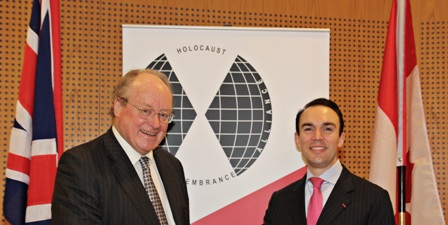
2014 UK Chair Sir Andrew Burns and 2013 Canadian Chair Dr. Mario Silva
