

 |
 |
 |
| WARKA JEWISH CEMETERY I
|
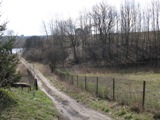
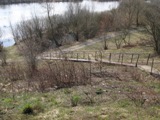
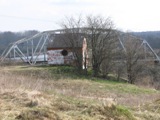
Details of Access: The cemetery is situated southwest of the town centre, on the left bank of the Pilica River, near the railway bridge, which was built between the wars. It is accessed from the town via Bielańska Street, by crossing public property and climbing a long flight of steps from the adjacent roadside.
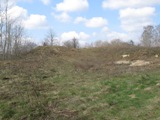
Location & Demarcation: The cemetery is located between fields and woods, situated in an isolated location at the crown of a hill Isolation overlooking the Pilica River. No road or entrance sign mark the site, and no gate, boundary wall or fence secures the site. Access is open to all. Jewish and non-Jewish private visitors visit the cemetery occasionally. The local municipality currently owns the cemetery site.
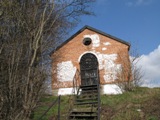
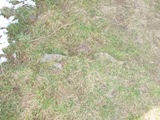
Graves, Gravestones, Memorial Markers & Structures: Present Cemetery Care: This unprotected cemetery was demolished during the Second World War and then converted into a recreation area and a pasture. Its current dimensions are 0.5 Hectares, whereas prior to WWII it measured 1.5 Hectares. The cemetery, established around 1795, has not a single remaining gravestone or even a single fragment of a tombstone. The last known Jewish burial took place at the beginning of 1942. In the 1990’s a red brick ohel was erected within the cemetery confines at the place where the tzaddik Rabbi Yisroel Yitzchak Kalish, also known as Reb Itzikel Vurke (1799-1848) is believed to have been buried. Metal stairs leading from the riverside were mounted leading to the ohel. Although the cemetery grounds are open, the ohel is locked.
Present Cemetery Care: The local authorities carry out occasional clearing or cleaning. However, the external walls of the ohel have been daubed with graffiti in recent years. The site is not secured and suffers from moderate overgrowth.
History of the Jewish Community: Jews settled down in Warka in the second half of the 18th century. Throughout decades they made up half of the local population. In 1800, Warka was inhabited by 359 Jews (51.5% of its population). According to “Geographic dictionary of the Polish Kingdom and other Slavic states” published in 1883, there were “165 houses (13 brick houses), 2760 inhabitants (1725 Jews, 62 Germans)” in Warka in 1857. The census dated 1921 quoted 50.5% of the Warka population who declared themselves Jewish. The Warka wooden synagogue is hailed in “Encyclopaedia of Jewish Life before and during the Holocaust” as one of “the most beautiful in Poland”. Warka was also one of the most important centres of Hasidism. The local dynasty of tzaddiks was started in 1829 by Izrael Icchak Kalisz (1779-1848), the student of renowned Jaakov Icchak Ha-Levi Horowitz from Lublin and Simcha Bunem from Przysucha. The teachings of Izrael Icchak were published in “Ohel Icchak” and “Huccak Chen”. His descendants led Hasidic communities in Warka, Otwock, Mszczonow (Amshinov). He taught, among others, future tzaddiks such as Jakoov Arie Guterman from Radzymin, Jechiel Danziger from Aleksandrov, Dov Ber from Biała Rawska. During WWI the dynasty moved its seat to Warsaw.
When the second world war broke out, some Jews fled Warka in quest for shelter in the Soviet-occupied zone. Those Jews who did not leave the town fell victim to severe repressions. In 1940, they were locked in a ghetto where many of them died of illnesses. In February 1941, the Jews were transported to the Treblinka camp. Only few survived the Holocaust.
Alternative Town Names: Varka, Варка, Vurka, Vurke, Vorke, וארקה, װורקע
 |
 |
 |
Source: E. Bindiger. Images © Lo Tishkach Foundation
