

 |
 |
 |
| RIGA BIKERNIEKI MASS GRAVES ADDRESS: Biķernieku iela, Riga, Latvia LO TISHKACH ID NO.: 10896 |
Alternative/Former City Names: Rīga (Latvian), Riia (Estonian), Riika (Finnish), Ryga (Lithuanian), Ryga (Polish), Рига (Russian)
Mass Grave Date: 1942 – 1944
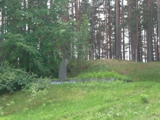
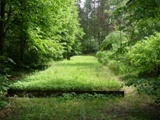
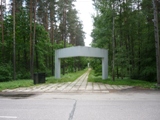
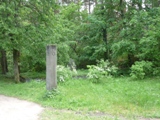
Location & Demarcation: Two separate areas containing a total of 55 known mass graves are located to both sides of Biķernieku iela, between Gunāra Astras iela/Lielvārdes iela in the west and Strautu iela/Sergeja Eizenšteina iela in the east. Both sites are located off the road inside the forest; on Biķernieku iela, stone tablets indicate their exact location. Individual mass graves are demarcated with concrete slabs. The sites are loosely demarcated with concrete memorial posts.
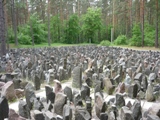
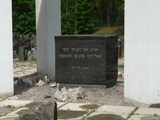
Memorial Markers & Structures: In addition to the memorial posts present in both mass grave areas, a memorial is located at the site south of Biķernieku iela. At its centre stands a black granite cube, surrounded by thousands of granite stones. Plaques loosely distributed around the memorial show the names of European cities from where Jews were deported to be killed in the Bikernieki Forest. Between 1941 and 1944, 35,000 Jews from Latvia and other European countries as well as Soviet prisoners of war and political prisoners were killed at the biggest Holocaust mass killing and burial site in Latvia.
History of the Jewish Community: According to records, 1536 was the first year of temporary presence of Jewish merchants in the city. During most of the 17th century, Jewish merchants were confined to stay at special inns (Judenherberge) located outside the city walls. Restrictions on Jewish settlement continued when Riga became part of the Russian Empire in 1721. The first permanent resident permits were granted to some of the city’s Jews in 1841. Ten years later, the rulers authorised the construction of a synagogue. By 1881, the number of Jews living in Riga had risen to 14,222, i.e. 8.4 per cent of the city’s total population. As elsewhere in the Russian Empire, Jews suffered severely from the 1881-82 pogroms, and many were killed or forced to leave Riga. Latvian independence between the two World Wars saw both the emancipation of Latvian Jews and an increase in political anti-Semitism. Shortly after their invasion of Latvia in June 1941, the Germans established a ghetto in Riga, whose 25,000 inhabitants were killed in mass shootings in November and December 1942. Until 1944, Jews from other European countries were deported to Riga and killed there. After the war, 3,000 Jews returned to Latvia. Following decades of heavy restrictions on religious and cultural activities under Soviet rule, the community was re-established in 1988. Today, it has 8,000 members.
 |
 |
 |
Source: Cemetery survey carried out by Lo Tishkach Research Co-ordinator Andreas Becker in June 2009. Images © Lo Tishkach Foundation
